TSUNAMI — Survive Your Ideas Word Guide
disaster family · resolves after acting · evidence: official
What TSUNAMI Does
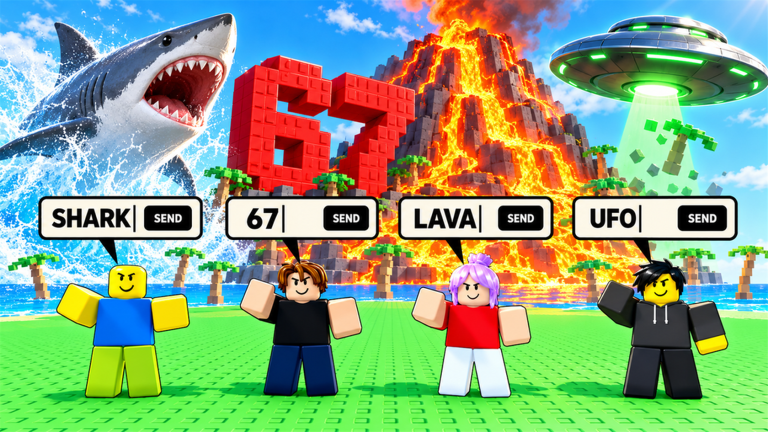
TSUNAMI belongs to the Disasters family of effects. Point-in-time area effects that resolve and clear. NUKE, TSUNAMI, BLACK HOLE. Like most non-persistent hazards, it acts over a defined window and then clears, letting the arena partially reset before the next typed word lands.
Evidence tier: official. Listed in the official game description (🌊 Tsunami?) and covered by every major outlet's first-wave coverage. We track three evidence levels on this wiki — official (the developer's own description or art), media (confirmed across multiple independent outlets), and community (single-source, labeled as such). This entry meets the wiki's verification bar for confirmed status.
How To Survive TSUNAMI
Flood-type hazard: climb to the highest platform you can reach before the wave lands, and keep one escape route in case an older stacked hazard blocks your perch. Without a mobility item, a Force Field is your only fallback — which is exactly why loadout guides rank the Grapple Hook first.
The general principle behind that advice: hazard families share counter-play shapes, and the five-slot loadout exists to answer families rather than individual words. A Grapple Hook covers every hazard you need to leave; a Force Field covers the ones you need to tank. Loadout composition is covered on the items and spins page.
TSUNAMI: The Deep Mechanics
TSUNAMI reshapes the arena's vertical economy. The flood transforms ground-level space from 'default safe' into 'temporarily lethal', and the match's positional math changes with it: height becomes currency, and players who spent the early minutes near elevated platforms hold an advantage that has nothing to do with reflexes. What makes the flood dangerous long-term is the stacking interaction — later hazards that force players down (a blast, a chaser's pressure) become dramatically more lethal while flood water is still active, because the safe ground they demand is already underwater.
The wave's timing profile also rewards map knowledge over reaction speed. The typed word gives the lobby the same warning a NUKE does, but a flood punishes slow vertical movement far more than slow horizontal movement — climbing takes longer than running, so the effective reaction window is shorter. Players who pre-position near climbable structures survive TSUNAMIs that catch faster players on flat ground. That is why experienced survivors loiter near verticality by default rather than treating it as a TSUNAMI-specific response.
As an offensive pick, TSUNAMI is the confirmed catalog's best combo word. On its own, into a spread lobby that holds high ground, it eliminates almost nobody. Typed immediately after a hazard that dragged players low — or into a lobby still recovering from the last disaster — it becomes arguably the highest single-word kill potential in the game. The wave does not create its own victims; it harvests the previous word's.
How TSUNAMI Fits The Wider Systems
Words never act alone in Survive Your Ideas — they land in an arena already shaped by the economy, the loadout and the badges. On the economy side, TSUNAMI feeds the loop like every catalogued word: typing it unlocks its Index entry and pays a one-time bonus into the fund that buys Meta Words (250K for /double, up to 750K for /jackpot — the full ladder is on the Meta Words page). On the loadout side, its family determines which of your five item slots earns its keep this match — mobility answers it if it moves you, defense answers it if it damages you, and the community-standard Grapple Hook plus Force Field core exists precisely because those two slots cover the most families at once. The full item logic is on the items page.
The badge system reads TSUNAMI two ways. Offensively, it is a tool for the skill badges — Deadly Idea rewards words that eliminate clustered players, and Champion rewards the endgame resource discipline that outlasts exactly this kind of hazard. Defensively, it is an obstacle on the way to the stamina badges — Survivor's 60-word threshold and Veteran's 100-match count are both earned in matches where hazards like this set the pace. The full badge map with official requirements is on the badges page, and the situation ranking that positions TSUNAMI against every other confirmed word is on best words.
When To Type TSUNAMI
Strongest when the arena floor is still crowded. Weak against players already on high ground, so combo it after a hazard that forced people down.
TSUNAMI And The Word Diary
Typing TSUNAMI — or being in a match where it gets typed, per current community reports about discovery credit — unlocks its Index entry in your Word Diary and pays a one-time Cash bonus. The diary feeds directly into your economy: those bonuses are the main non-survival Cash source, and Cash gates all six Meta Words on the shop's Cash side, from /double at 250K up to /jackpot at 750K. If you are systematically filling the diary, check the Cash Planner to see when each Meta Word lands at your actual play pace, and the best words ranking for where TSUNAMI sits against the rest of the confirmed list.
Words In The Same Family
NUKE, BLACK HOLE. From other families: DINOSAUR, TACOS, ZOMBIES, METEOR.
TSUNAMI FAQ
What does TSUNAMI do in Survive Your Ideas?
How do you survive TSUNAMI?
Is TSUNAMI a good word to type?
How long does TSUNAMI last?
Where does TSUNAMI come from — is it officially confirmed?
Does typing TSUNAMI unlock it in the Word Diary?
Can Meta Words like /double or /secret be combined with TSUNAMI?
Is TSUNAMI affected by game updates?
Data checked November 8, 2026. Survive Your Ideas updates often — we re-verify codes and numbers after each update.